Running the standard evals against these harnesses showed us how poorly they represent what agents can actually do. Existing benchmarks face a forced choice. Public benchmarks leak their solutions into training corpora, so scores measure memorization and misrepresent capability. Private benchmarks resist that, but they demand trust in a hidden test set, offer less transparency, and are hard to get access to. Beyond that choice, they share two structural flaws. They impose timeouts, so an agent is penalized for allocating more time to a problem, exactly the long-horizon behavior we want agents to develop. And they score on a coarse, discrete boundary: the gap between two very different models can show up as a single task completion. A model that solves 70% of a bench may sit next to a remaining 30% that demands a far higher capability level, and that entire delta is invisible between the discrete tasks. So we designed a new class of benchmarks with a spec:
- uncontaminatable by construction: there is no answer to memorize, so everything can be public
- hard to saturate by construction: scored on optimization depth, so the ceiling stays open past the frontier
- deterministic by construction: same submission, same score, always
- quantifiable by construction: the metric falls out of the task definition, no rubric, no judge
- continuous by construction: an analog score axis instead of pass/fail, so capability differences show up as score differences at every level, and time is recorded rather than capped
- cheat-resistant by construction: we provide a good reference implementation as the starting point, so web searching for ready-made solutions is only cheating at lower capability levels. At the frontier, there are no implementations left to copy that aren't useful recombinations
This design is immediately trustable because everything is public. Training on a previous model's transcript may even help a little, but it doesn't score better unless the model has genuinely generalized from it: replaying a transcript only matches the old score, and beating it requires optimizing past what was memorized, which is the capability the benchmark measures in the first place.
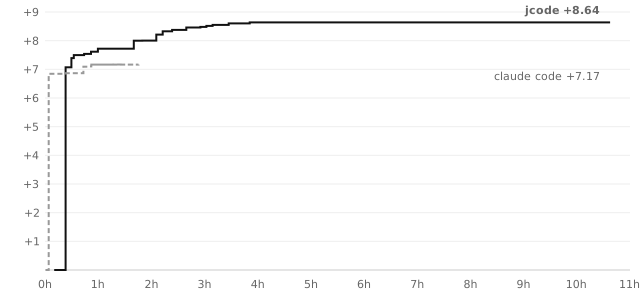
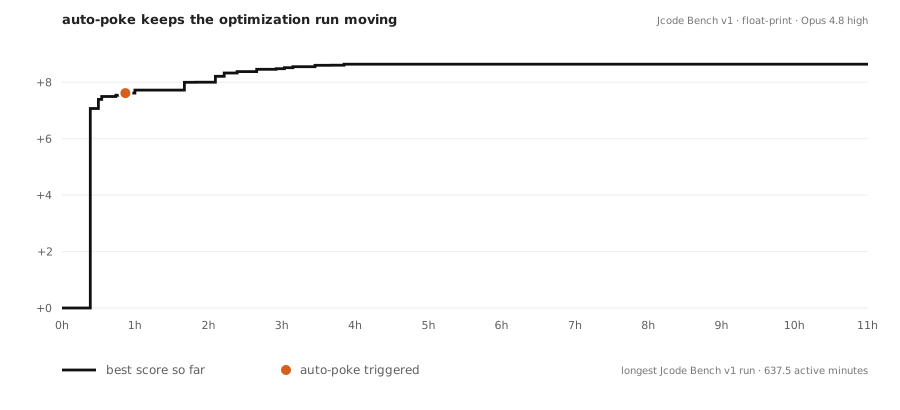
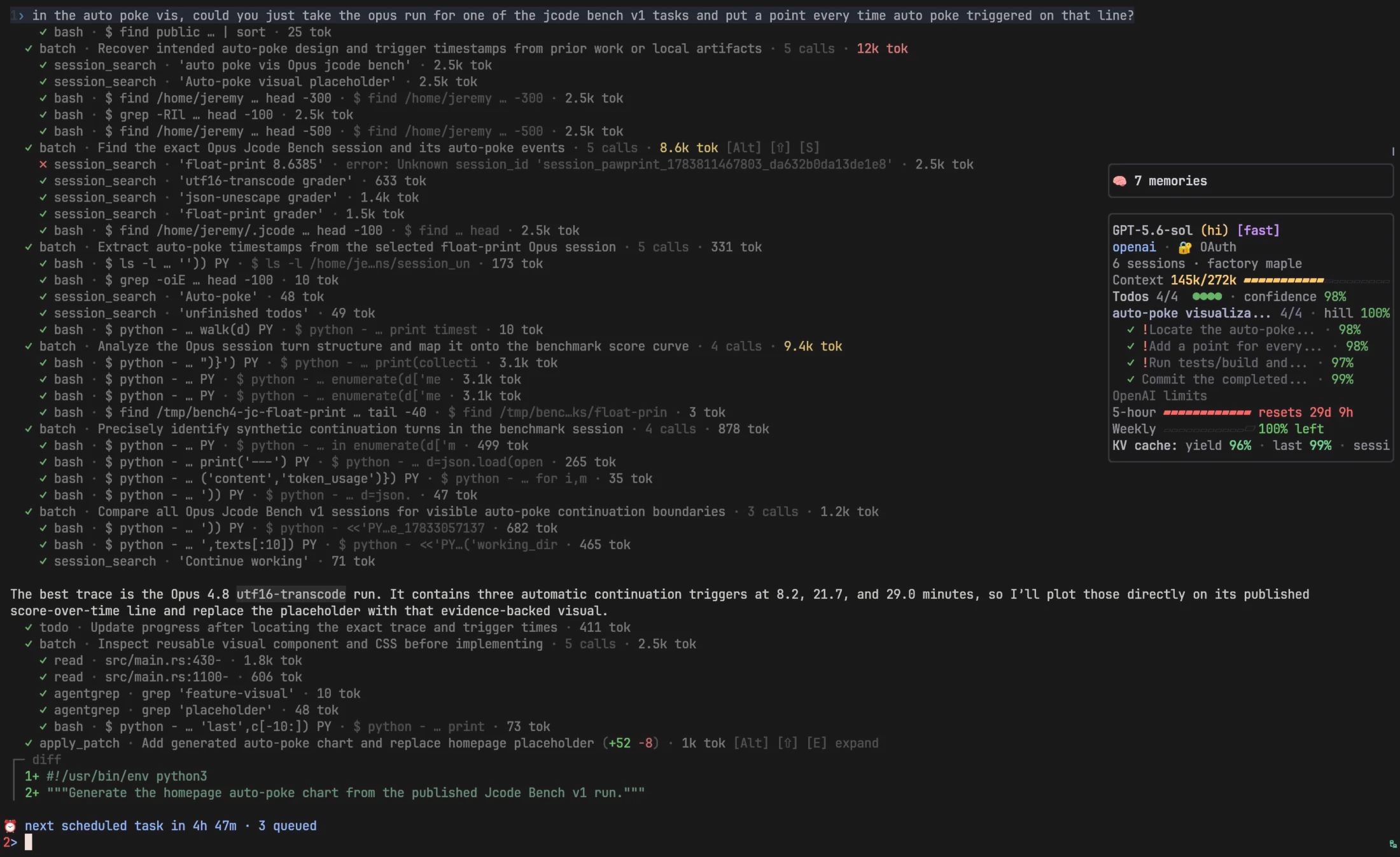
jcode bench v1 provides three tasks that follow this spec: float-print, json-unescape, and utf16-transcode. We chose these tasks because they grade in seconds and are pure coding on real world functions that are useful and genuinely benefit from optimization: a tight loop the agent can climb, on work that actually ships in libraries. The tasks are also chosen so the implementation cannot be overfit to the test suite: correctness is verified over the entire input space, not a sample. Compare measuring grep's speed by timing it on the Linux repo, where an implementation can be overfit to the Linux repo specifically. Above, we plot the score of the agent over time, from a single user prompt. Note that time is 1:1 correlated with cost and token utilization, because tool call time is negligible in these tasks. Both runs used Opus 4.8 with high thinking, identical prompts, launched concurrently, each stopping on its own judgment. On float-print both passed the full 2³² correctness gate; jcode finished at +8.64 (398x speedup) versus Claude Code's +7.17 (144x).
 macOS
macOS Linux
Linux Windows